SECURITY
A practical, non-mathematical walkthrough of why current encryption is at risk and how post-quantum cryptography helps prepare systems for the future.
Much of today's secure communication depends on cryptographic problems that are difficult for classical computers to solve. Large-scale fault-tolerant quantum computers could eventually change that assumption. Post-quantum cryptography focuses on algorithms designed to remain secure against both classical and quantum adversaries.
The harvest now, decrypt later threat
An attacker does not need a quantum computer today to create risk. They can collect encrypted data now, store it and wait until future computing capabilities make decryption possible.
This matters most for information with a long confidentiality lifetime, such as healthcare records, legal documents, intellectual property, government communications and sensitive financial information.
Hybrid approaches are the pragmatic path
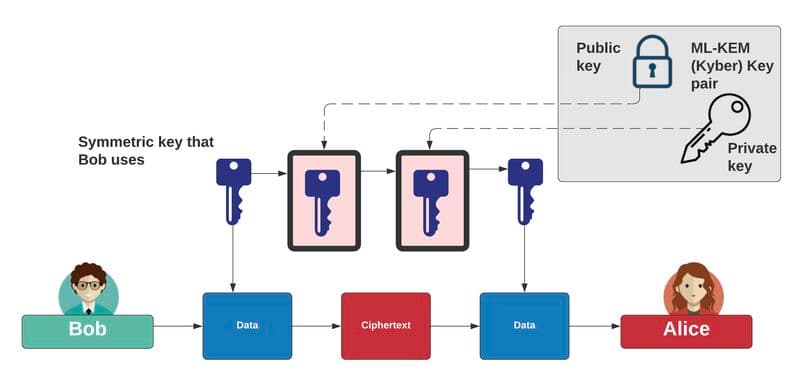
Moving to post-quantum cryptography does not mean abandoning existing symmetric encryption such as AES-GCM. In practical systems, post-quantum algorithms can establish or protect encryption keys, while symmetric encryption protects the actual file or message content.
A hybrid approach can also combine classical and post-quantum key exchange during the transition period. This reduces migration risk and avoids depending entirely on a single new cryptographic mechanism.
ML-KEM provides a practical building block
ML-KEM is a post-quantum key-encapsulation mechanism designed for securely establishing shared secrets. Applications can use that shared secret to derive keys for authenticated symmetric encryption.
In a secure file-storage workflow, a file can be encrypted with a random AES key, while ML-KEM protects the key needed to decrypt that file. This is one example of combining post-quantum key establishment with efficient symmetric encryption.
Standardization is already happening
Post-quantum cryptography is no longer only an academic topic. Standardized algorithms and growing infrastructure support give engineers concrete building blocks for planning migration paths.
The practical next step for many teams is not to replace everything immediately, but to identify long-lived sensitive data, locate public-key cryptography dependencies and begin designing crypto-agility into new systems.
Enjoyed this article?
Get new posts in your inbox.
Occasional writing about software engineering, AI, security, cloud infrastructure, and the projects I build.
No spam. Unsubscribe whenever you want.
Topics